Wednesday, August 15, 2007


Friday, July 06, 2007
American Capitalism and Vacation
REPORT: AMERICA IS THE 'NO VACATION NATION' REUTERS - As Europe's workers take a few weeks of holiday this summer, their American colleagues will be lucky to get a few days off work, says a report published by the European Trade Union Institute. Finland, followed by France, offers working people the most statutory vacation, at more than six weeks per year, the report, an international snapshot of how much paid leave people get by law and in practice in 21 countries, says. The United States is the only country where employees have no statutory leave, and they get about half as much time off in reality as Europeans get, according to the report, compiled by the Washington-based Centre for Economic Policy Research. "The United States is in a class of its own," the report says. "It is the no-vacation nation."http://www.reuters.com/article/domesticNews/idUSL0522341220070705
Capitalism And War
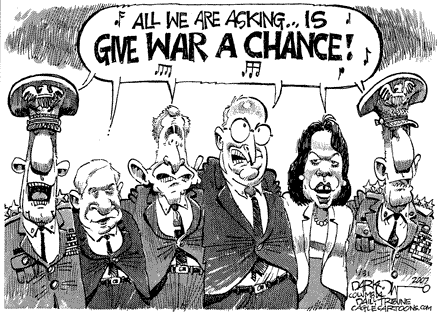
PRIVATE CONTRACTORS OUTNUMBER U.S. TROOPS IN IRAQT. CHRISTIAN MILLER, LA TIMES - The number of U.S.-paid private contractors in Iraq now exceeds that of American combat troops, newly released figures show, raising fresh questions about the privatization of the war effort and the government's capacity to carry out military and rebuilding campaigns. More than 180,000 civilians -- including Americans, foreigners and Iraqis -- are working in Iraq under U.S. contracts, according to State and Defense department figures obtained by the Los Angeles Times. Including the recent troop buildup, 160,000 soldiers and a few thousand civilian government employees are stationed in Iraq.http://www.latimes.com/news/printedition/front/la-na-private4jul04,1,6564316.story?ctrack=4&cset=true
Friday, June 29, 2007
See Sicko
Sicko will perhaps be the catalyst to change our criminally negligent health care system.
http://www.reelzchannel.com/moviedetail.aspx?movieid=226829&gclid=CMWPh-S1g40CFRuNYAodHjYAiQ
http://www.reelzchannel.com/moviedetail.aspx?movieid=226829&gclid=CMWPh-S1g40CFRuNYAodHjYAiQ
Wednesday, June 20, 2007
Einstein Speaks

Life is like riding a bicycle. To keep your balance you must keep moving. Albert Einstein
Monday, June 11, 2007
Iraq Labor Movement
Iraq's Workers Strike to Keep Their Oil By David Bacon t r u t h o u t Columnist, Saturday 09 June 2007http://www.truthout.org/docs_2006/060907A.shtml The Bush administration has no love for unions anywhere, but in Iraq it has a special reason for hating them. They are the main opposition to the occupation's economic agenda, and the biggest obstacle to that agenda's centerpiece - the privatization of Iraq's oil. At the same time, unions have become the only force in Iraq trying to maintain at least a survival living standard for the millions of Iraqis who still have to go to work every day, in the middle of the war. This week, Iraqi anger over starvation incomes and oil ripoffs boiled over. On Monday, June 4, the biggest and strongest of the Iraqi unions, the Iraqi Federation of Oil Unions, launched a limited strike to underline its call for keeping oil in public hands, and to force the government to live up to its economic promises. Workers on the pipelines carrying oil from the rigs in the south to Baghdad's big refinery stopped work. It was a very limited job action, which still allowed the Iraqi economy to function. Iraqi Prime Minister Nouri al-Maliki responded by calling out the army and surrounding the strikers at Sheiba, near Basra. Then he issued arrest warrants for the union's leaders. On Wednesday, June 6, the union postponed the strike until June 11. Labor unrest could not only resume at that point, but could easily escalate into shutdowns on the rigs themselves, or even the cutoff of oil exports. That would shut down the income stream that keeps the Maliki regime in power in Baghdad. Some of the oil workers' demands reflect the desperate situation of workers under the occupation. They want their employer - the government's oil ministry - to pay for wage increases and promised vacations, and give permanent status to thousands of temporary employees. In a country where housing has been destroyed on a massive scale, and workers often live in dilapidated and primitive conditions, the union wants the government to turn over land for building homes. Every year, the oil institute has miraculously continued holding classes and training technicians, yet the ministry won't give work to graduates, despite the war-torn industry's desperate need for skilled labor. The union demands jobs and a future for these young people. But one demand overshadows even these basic needs - renegotiation of the oil law that would turn the industry itself over to foreign corporations. And it is this demand that has brought out even the US fighter jets, which have circled and buzzed over the strikers' demonstrations. In Iraq, the hostile maneuvering of military aircraft is not an idle threat to the people below. This standoff reflects a long history of actions in Iraq, by both the Iraqi government and the US occupation administration, to suppress union activity. Iraq has a long labor history. Union activists, banned and jailed under the British and its puppet monarchy, organized a labor movement that was the admiration of the Arab world when Iraq became independent after 1958. Saddam Hussein later drove its leaders underground, killing and jailing the ones he could catch.
When Saddam fell, Iraqi unionists came out of prison, up from underground and back from exile, determined to rebuild its labor movement. Miraculously, in the midst of war and bombings, they did. The oil workers union in the south is now one of the largest organizations in Iraq, with thousands of members on the rigs, pipelines and refineries. The electrical workers union is the first national labor organization headed by a woman, Hashmeya Muhsin Hussein. Together with other unions in railroads, hotels, ports, schools and factories, they've gone on strike, held elections, won wage increases and made democracy a living reality. Yet the Bush administration, and the Baghdad government it controls, has outlawed collective bargaining, impounded union funds and turned its back (or worse) on a wave of assassinations of Iraqi union leaders. President Bush says he wants democracy, yet he will not accept the one political demand that unites Iraqis above all others. They want the country's oil (and its electrical power stations, ports and other key facilities) to remain in public hands.
The fact that Iraqi unions are the strongest voice demanding this makes them anathema. Selling the oil off to large corporations is far more important to the Bush administration than a paper commitment to the democratic process. Iraq's oil was nationalized in the 1960s, like that of every other country in the Middle East. The Iraqi oil union became, and still is, the industry's most zealous guardian.Holding a no-bid, sweetheart contract with occupation authorities, Halliburton Corporation came into Iraq in the wake of the troops in 2003. The company tried to seize control of the wells and rigs, withholding reconstruction aid to force workers to submit. The oil union struck for three days that August, stopping exports and cutting off government revenue. Halliburton left. The oil and port unions then forced foreign corporations to give up similar sweetheart agreements in Iraq's deepwater shipping facilities. Muhsin's electrical union is still battling to stop subcontracting in the power stations - a prelude to corporate control. The occupation has always had an economic agenda. Occupation czar Paul Bremer published lists in Baghdad newspapers of the public enterprises he intended to auction off. Arab labor leader Hacene Djemam bitterly observed, "War makes privatization easy: first you destroy society; then you let the corporations rebuild it." The Bush administration won't leave Iraq in part because that economic agenda is still insecure. Under Washington's guidance, the Iraqi government wrote a new oil law in secret. The Iraq study commission, headed by oilman James Baker, called it the key to ending the occupation.That law is touted in the US press as ensuring an equitable division of oil wealth. Iraqi unions say it will ensure that foreign corporations control future exploration and development, in one of the world's largest reserves. Hassan Juma'a Awad, president of the IFOU, wrote a letter to the US Congress on May 13. "Everyone knows the oil law doesn't serve the Iraqi people," he warned. The union was banned from the secret negotiations. According to Juma'a, the result "serves Bush, his supporters and foreign companies at the expense of the Iraqi people." The union has threatened to strike if the law is implemented. Like all Iraqi unionists, Juma'a says the occupation should end without demanding Iraq's oil as a price. "The USA claimed that it came here as a liberator, not to control our resources," he reminded Congress. Congressional opponents of the war can only win Iraqis' respect if they disavow the oil law.
Whatever government holds power in Baghdad at the occupation's end will need control of the oil wealth to rebuild the devastated country. That gives Iraq's working people a big reason to fight to ensure that happens.
Two Iraqi union leaders, Faleh Abood Umara and Hashmeya Muhsin Hussein, are speaking in the United States about their situation in Iraq. For details about times and places, contact US Labor Against the War:
http://www.uslaboragainstwar.org/article.php?id=12200
For more articles and images on Iraq's unions, see http://dbacon.igc.org/Iraq/iraq.htm
See also the photodocumentary on indigenous migration to the US, Communities Without Borders (Cornell University/ILR Press, 2006)
http://www.cornellpress.cornell.edu/cup_detail.taf?ti_id=4575
See also The Children of NAFTA, Labor Wars on the U.S./Mexico Border (University of California, 2004)
http://www.ucpress.edu/books/pages/9989.html--
__________________________________David Bacon, Photographs and Storieshttp://dbacon.igc.org__________________________________
When Saddam fell, Iraqi unionists came out of prison, up from underground and back from exile, determined to rebuild its labor movement. Miraculously, in the midst of war and bombings, they did. The oil workers union in the south is now one of the largest organizations in Iraq, with thousands of members on the rigs, pipelines and refineries. The electrical workers union is the first national labor organization headed by a woman, Hashmeya Muhsin Hussein. Together with other unions in railroads, hotels, ports, schools and factories, they've gone on strike, held elections, won wage increases and made democracy a living reality. Yet the Bush administration, and the Baghdad government it controls, has outlawed collective bargaining, impounded union funds and turned its back (or worse) on a wave of assassinations of Iraqi union leaders. President Bush says he wants democracy, yet he will not accept the one political demand that unites Iraqis above all others. They want the country's oil (and its electrical power stations, ports and other key facilities) to remain in public hands.
The fact that Iraqi unions are the strongest voice demanding this makes them anathema. Selling the oil off to large corporations is far more important to the Bush administration than a paper commitment to the democratic process. Iraq's oil was nationalized in the 1960s, like that of every other country in the Middle East. The Iraqi oil union became, and still is, the industry's most zealous guardian.Holding a no-bid, sweetheart contract with occupation authorities, Halliburton Corporation came into Iraq in the wake of the troops in 2003. The company tried to seize control of the wells and rigs, withholding reconstruction aid to force workers to submit. The oil union struck for three days that August, stopping exports and cutting off government revenue. Halliburton left. The oil and port unions then forced foreign corporations to give up similar sweetheart agreements in Iraq's deepwater shipping facilities. Muhsin's electrical union is still battling to stop subcontracting in the power stations - a prelude to corporate control. The occupation has always had an economic agenda. Occupation czar Paul Bremer published lists in Baghdad newspapers of the public enterprises he intended to auction off. Arab labor leader Hacene Djemam bitterly observed, "War makes privatization easy: first you destroy society; then you let the corporations rebuild it." The Bush administration won't leave Iraq in part because that economic agenda is still insecure. Under Washington's guidance, the Iraqi government wrote a new oil law in secret. The Iraq study commission, headed by oilman James Baker, called it the key to ending the occupation.That law is touted in the US press as ensuring an equitable division of oil wealth. Iraqi unions say it will ensure that foreign corporations control future exploration and development, in one of the world's largest reserves. Hassan Juma'a Awad, president of the IFOU, wrote a letter to the US Congress on May 13. "Everyone knows the oil law doesn't serve the Iraqi people," he warned. The union was banned from the secret negotiations. According to Juma'a, the result "serves Bush, his supporters and foreign companies at the expense of the Iraqi people." The union has threatened to strike if the law is implemented. Like all Iraqi unionists, Juma'a says the occupation should end without demanding Iraq's oil as a price. "The USA claimed that it came here as a liberator, not to control our resources," he reminded Congress. Congressional opponents of the war can only win Iraqis' respect if they disavow the oil law.
Whatever government holds power in Baghdad at the occupation's end will need control of the oil wealth to rebuild the devastated country. That gives Iraq's working people a big reason to fight to ensure that happens.
Two Iraqi union leaders, Faleh Abood Umara and Hashmeya Muhsin Hussein, are speaking in the United States about their situation in Iraq. For details about times and places, contact US Labor Against the War:
http://www.uslaboragainstwar.org/article.php?id=12200
For more articles and images on Iraq's unions, see http://dbacon.igc.org/Iraq/iraq.htm
See also the photodocumentary on indigenous migration to the US, Communities Without Borders (Cornell University/ILR Press, 2006)
http://www.cornellpress.cornell.edu/cup_detail.taf?ti_id=4575
See also The Children of NAFTA, Labor Wars on the U.S./Mexico Border (University of California, 2004)
http://www.ucpress.edu/books/pages/9989.html--
__________________________________David Bacon, Photographs and Storieshttp://dbacon.igc.org__________________________________
Wednesday, May 30, 2007
Bush Democrats Shame on You
http://www.democrats.com/events_cat/Democratic+Primary+2008
Above is a link to the list and an effort to create a more progressive Democratic Party. Good Luck
Above is a link to the list and an effort to create a more progressive Democratic Party. Good Luck
Thursday, May 03, 2007

Wednesday, May 02, 2007
George Tenet Maureen Dowd
--------------------------------------------------------------------------------May 2, 2007, NYT Op-Ed Columnist Better Never Than Late By MAUREEN DOWD Instead of George Tenet teaching at Georgetown University, George Tenet should be taught at Georgetown University.There should be a course on government called "The Ultimate Staff Guy." A morality saga about how much harm you can do as a go-along, get-along guy, spending so much time trying not to alienate the big cheese so he doesn't can you that you miss the moment where you have to can him or lose your soul.If Colin Powell and George Tenet had walked out of the administration in February 2003 instead of working together on that tainted U.N. speech making the bogus case for war, they might have turned everything around. They might have saved the lives and limbs of all those brave U.S. kids and innocent Iraqis, not to mention our world standing and national security.It would certainly have been harder for timid Democrats, like Hillary Clinton, John Kerry and John Edwards, to back up the administration if two members of the Bush inner circle had broken away to tell an increasingly apparent truth: that Dick Cheney, Rummy and the neocons were feverishly pushing a naïve president into invading Iraq with junk facts.General Powell counted on Slam Dunk - a slender reed - to help him rid the speech of most of the garbage Mr. Cheney's office wanted in it. Slam, of course, tried to have it both ways, helping the skeptical secretary of state and pandering to higher bosses. Afterward, when the speech turned out to be built on a no-legged stool, General Powell was furious at Slam. But they both share blame: they knew better. They put their loyalty to a runaway White House ahead of their loyalty to a fearful public. Slam Dunk's book tour is mesmerizing, in a horrifying way. "The irony of the whole situation is, is he was bluffing," Slam said of Saddam on "Larry King Live" on Monday night, adding, "And he didn't know we weren't." Mr. He-Man Tenet didn't understand the basics of poker, much less Arab culture. It never occurred to him that Saddam might feign strength to flex muscles at his foes in the Middle East? Slam couldn't take some of that $40 billion we spend on intelligence annually and get a cultural profile of the dictator before we invaded?If he was really running around with his hair on fire, knowing the Osama danger, shouldn't he have set off alarms when W. and Vice went after Saddam instead of the real threat? Many people in Washington snorted at his dramatic cloak-and-dagger description of himself to Larry King: "I worked in the shadows my whole life."He was not Jason Bourne, lurking in dangerous locales. He risked life and limb on Capitol Hill among the backstabbers and cutthroat bureaucrats - from whom he obviously learned a lot. He spent nine years on the staff of the Senate Intelligence Committee, four as staff director. When Bill Clinton appointed him to run the C.I.A. in 1997, the profile of him in The Times was headlined "A Time to Reap the Rewards of Being Loyal." It observed that old colleagues had said "he had an ability to make many different superiors feel at ease with him."Six former C.I.A. officials sent Mr. Tenet a letter via his publisher - no wonder we're in trouble if spooks can't figure out the old Head Spook's home address - berating him for pretending he wrote his self-serving book partly to defend the honor of the agency and demanding that "at least half" of the profits be given to wounded soldiers and the families of dead soldiers (there needs to be a Son of Slam law). One of the signers, Larry Johnson, told CNN that Slam "is profiting from the blood of American soldiers.""By your silence you helped build the case for war," the former C.I.A. officials wrote. "You betrayed the C.I.A. officers who collected the intelligence that made it clear that Saddam did not pose an imminent threat. You betrayed the analysts who tried to withstand the pressure applied by Cheney and Rumsfeld." They also said, "Although C.I.A. officers learned in late September 2002 from a high-level member of Saddam Hussein's inner circle that Iraq had no past or present contact with Osama bin Laden and that the Iraqi leader considered Bin Laden an enemy ... you still went before Congress in February 2003 and testified that Iraq did indeed have links to Al Qaeda. ..."In the end you allowed suspect sources, like Curveball, to be used based on very limited reporting and evidence." They concluded that "your tenure as head of the C.I.A. has helped create a world that is more dangerous. ... It is doubly sad that you seem still to lack an adequate appreciation of the enormous amount of death and carnage you have facilitated." Thus endeth the lesson in our class on "The Ultimate Staff Guy." If you have something deadly important to say, say it when it matters, or just shut up and slink off.
Another thanks to BT for sending me this.
GT
Another thanks to BT for sending me this.
GT
Tuesday, April 24, 2007
New Island
GREENLAND'S NEW ISLAND IS ALARMING SIGN OF CLIMATE CHANGE MICHAEL MCCARTHY, INDEPENDENT, UK - The map of Greenland will have to be redrawn. A new island has appeared off its coast, suddenly separated from the mainland by the melting of Greenland's enormous ice sheet, a development that is being seen as the most alarming sign of global warming. Several miles long, the island was once thought to be the tip of a peninsula halfway up Greenland's remote east coast but a glacier joining it to the mainland has melted away completely, leaving it surrounded by sea. . .The second-largest ice sheet in the world (after Antarctica), if its entire 2.5 million cubic kilometers of ice were to melt, it would lead to a global sea level rise of 7.2 meters, or more than 23 feet. That would inundate most of the world's coastal cities, including London, swamp vast areas of heavily-populated low-lying land in countries such as Bangladesh, and remove several island countries such as the Maldives from the face of the Earth. However, even a rise one tenth as great would have devastating consequences.http://news.independent.co.uk/environment/climate_change/article2480994.ece
Wednesday, March 28, 2007
Compromise And The War by Howard Zinn
By Howard Zinn May 2007 Issue of The Progressive: As I write this, Congress is debating timetables for withdrawal from Iraq. In response to the Bush Administration's "surge" of troops, and the Republicans' refusal to limit our occupation, the Democrats are behaving with their customary timidity, proposing withdrawal, but only after a year, or eighteen months. And it seems they expect the anti-war movement to support them.That was suggested in a recent message from MoveOn, which polled its members on the Democrat proposal, saying that progressives in Congress, "like many of us, don't think the bill goes far enough, but see it as the first concrete step to ending the war."Ironically, and shockingly, the same bill appropriates $124 billion in more funds to carry the war. It's as if, before the Civil War, abolitionists agreed to postpone the emancipation of the slaves for a year, or two years, or five years, and coupled this with an appropriation of funds to enforce the Fugitive Slave Act.When a social movement adopts the compromises of legislators, it has forgotten its role, which is to push and challenge the politicians, not to fall in meekly behind them.We who protest the war are not politicians. We are citizens. Whatever politicians may do, let them first feel the full force of citizens who speak for what is right, not for what is winnable, in a shamefully timorous Congress.We who protest the war are not politicians. We are citizens. Whatever politicians may do, let them first feel the full force of citizens who speak for what is right, not for what is winnable, in a shamefully timorous Congress.Timetables for withdrawal are not only morally reprehensible in the case of a brutal occupation (would you give a thug who invaded your house, smashed everything in sight, and terrorized your children a timetable for withdrawal?) but logically nonsensical. If our troops are preventing civil war, helping people, controlling violence, then why withdraw at all? If they are in fact doing the opposite-provoking civil war, hurting people, perpetuating violence-they should withdraw as quickly as ships and planes can carry them home.It is four years since the United States invaded Iraq with a ferocious bombardment, with "shock and awe." That is enough time to decide if the presence of our troops is making the lives of the Iraqis better or worse. The evidence is overwhelming. Since the invasion, hundreds of thousands of Iraqis have died, and, according to the UN High Commissioner for Refugees, about two million Iraqis have left the country, and an almost equal number are internal refugees, forced out of their homes, seeking shelter elsewhere in the country.Yes, Saddam Hussein was a brutal tyrant. But his capture and death have not made the lives of Iraqis better, as the U.S. occupation has created chaos: no clean water, rising rates of hunger, 50 percent unemployment, shortages of food, electricity, and fuel, a rise in child malnutrition and infant deaths. Has the U.S. presence diminished violence? On the contrary, by January 2007 the number of insurgent attacks has increased dramatically to 180 a day.The response of the Bush Administration to four years of failure is to send more troops. To add more troops matches the definition of fanaticism: If you find you're going in the wrong direction, redouble your speed. It reminds me of the physician in Europe in the early nineteenth century who decided that bloodletting would cure pneumonia. When that didn't work, he concluded that not enough blood had been let.The Congressional Democrats' proposal is to give more funds to the war, and to set a timetable that will let the bloodletting go on for another year or more. It is necessary, they say, to compromise, and some anti-war people have been willing to go along. However, it is one thing to compromise when you are immediately given part of what you are demanding, if that can then be a springboard for getting more in the future. That is the situation described in the recent movie The Wind That Shakes The Barley, in which the Irish rebels against British rule are given a compromise solution-to have part of Ireland free, as the Irish Free State. In the movie, Irish brother fights against brother over whether to accept this compromise. But at least the acceptance of that compromise, however short of justice, created the Irish Free State. The withdrawal timetable proposed by the Democrats gets nothing tangible, only a promise, and leaves the fulfillment of that promise in the hands of the Bush Administration.There have been similar dilemmas for the labor movement. Indeed, it is a common occurrence that unions, fighting for a new contract, must decide if they will accept an offer that gives them only part of what they have demanded. It's always a difficult decision, but in almost all cases, whether the compromise can be considered a victory or a defeat, the workers have been given some thing palpable, improving their condition to some degree. If they were offered only a promise of something in the future, while continuing an unbearable situation in the present, it would not be considered a compromise, but a sellout. A union leader who said, "Take this, it's the best we can get" (which is what the MoveOn people are saying about the Democrats' resolution) would be hooted off the platform.I am reminded of the situation at the 1964 Democratic National Convention in Atlantic City, when the black delegation from Mississippi asked to be seated, to represent the 40 percent black population of that state. They were offered a "compromise"-two nonvoting seats. "This is the best we can get," some black leaders said. The Mississippians, led by Fannie Lou Hamer and Bob Moses, turned it down, and thus held on to their fighting spirit, which later brought them what they had asked for. That mantra-"the best we can get"-is a recipe for corruption.It is not easy, in the corrupting atmosphere of Washington, D.C., to hold on firmly to the truth, to resist the temptation of capitulation that presents itself as compromise. A few manage to do so. I think of Barbara Lee, the one person in the House of Representatives who, in the hysterical atmosphere of the days following 9/11, voted against the resolution authorizing Bush to invade Afghanistan. Today, she is one of the few who refuse to fund the Iraq War, insist on a prompt end to the war, reject the dishonesty of a false compromise.Except for the rare few, like Barbara Lee, Maxine Waters, Lynn Woolsey, and John Lewis, our representatives are politicians, and will surrender their integrity, claiming to be "realistic."We are not politicians, but citizens. We have no office to hold on to, only our consciences, which insist on telling the truth. That, history suggests, is the most realistic thing a citizen can do.Howard Zinn is the author, most recently, of "A Power Governments Cannot Suppress."
Thanks again to Bob T. for this.
Thanks again to Bob T. for this.
Wednesday, March 21, 2007
SDS Documentary.
sds documentary "Rebels with a cause", available on google: http://video.google.com/videoplay?docid=3748224138549545719
I did some of the incidental music for this film.
I did some of the incidental music for this film.
Wednesday, March 14, 2007
The Pragmatism of Prolonged War Norman Solomon
The Pragmatism of Prolonged War
by Norman Solomon
The days are getting longer, but the media shadows are no shorter as they cover the war in Iraq through American eyes, squinting in Washington's pallid sun.
Debated as an issue of politics, the actual war keeps being drained of life. Abstractions thrive inside the Beltway, while the war effort continues: funded by the U.S. Treasury every day, as the original crime of invasion is replicated with occupation.
More than ever, in the aftermath of the Scooter Libby verdict, the country's major news outlets are willing to acknowledge that the political road to war in Iraq was paved with deceptions. But the same media outlets were integral to laying the flagstones along the path to war -- and they're now integral to prolonging the war.
With the same logic of one, two, and three years ago, the conformist media wisdom is that a cutoff of funds for the war is not practical. Likewise, on Capitol Hill, there's a lot of huffing and puffing about how the war must wind down -- but the money for it, we're told, must keep moving. Like two rails along the same track, the dispensers of conventional media and political wisdom carry us along to more and more and more war.
The antiwar movement is now coming to terms with measures being promoted by Senate Majority Leader Harry Reid and House Speaker Nancy Pelosi.
Pelosi and Reid have a job to do. The antiwar movement has a job to do. The jobs are not the same.
This should be obvious -- but, judging from public and private debates now fiercely underway among progressive activists and organizations, there's a lot of confusion in the air.
No amount of savvy Capitol-speak can change the fact that "benchmarks" are euphemisms for more war. And when activists pretend otherwise, they play into the hands of those who want the war to go on... and on... and on.
Deferring to the Democratic leadership means endorsing loopholes that leave the door wide open for continued U.S. military actions inside Iraq -- whether justified as attacks on fighters designated as Al Qaeda in Iraq, or with reclassification of U.S. forces as "trainers" rather than "combat troops." And an escalating U.S. air war could continue to bomb Iraqi neighborhoods for years.
The position being articulated by Reps. Barbara Lee, Maxine Waters, Lynn Woolsey and others in Congress is the one that the antiwar movement should unite behind -- to fully fund bringing the troops home in a safe and orderly way, while ending the entire U.S. occupation and war effort, by the end of 2007.
We're urged to take solace from the fact that Washington's debate has shifted to "when" -- rather than "whether" -- the war should end. But the end of the U.S. war effort could be deferred for many more years while debates over "when" flourish and fester. This happened during the Vietnam War, year after year, while death came to tens of thousands more American soldiers and perhaps a million more Vietnamese people.
Pelosi is speaker of the House, and Reid is majority leader of the Senate. But neither speaks for, much less leads, the antiwar movement that we need.
When you look at the practicalities of the situation, Pelosi and Reid could be more accurately described as speaker and leader for the war-management movement.
A historic tragedy is that the most hefty progressive organization, MoveOn, seems to have wrapped itself around the political sensibilities of Reid, Pelosi and others at the top of Capitol Hill leadership. Deference to that leadership is a big mistake. We already have a Democratic Party. Over time, a vibrant progressive group loses vibrance by forfeiting independence and becoming a virtual appendage of party leaders.
Last week, while MoveOn was sending out a mass e-mail to its 3.2 million members offering free bumper stickers urging "End This War," the MoveOn leadership was continuing its failure to back the efforts of the Congressional Progressive Caucus for "a fully funded, and systematic, withdrawal of U.S. soldiers and military contractors from Iraq."
There are rationales for uniting behind practical measures, and sometimes they make sense. But the MoveOn pattern has been unsettling and recurring. Power brokerage is not antiwar leadership.
The U.S. Constitution and the federal courts are clear: Only through the "power of the purse" can Congress end a war. It's good to see MoveOn churning out bumper stickers that advocate an end to the Iraq war -- but sad to see its handful of decision-makers failing to support a measure to fund an orderly and prompt withdrawal from the war.
On Capitol Hill, most Democrats seem to have settled on a tactical approach of simultaneously ratifying and deploring the continuation of the war. The approach may or may not be savvy politics in a narrow sense of gaining temporary partisan political advantage. But it is ultimately destructive to refuse to do the one thing that the Constitution empowers Congress to do to halt a U.S. war -- stop appropriating taxpayer money for it.
In retrospect, such congressional behavior during the Vietnam War -- while attracting sober approval from much of the era's punditocracy -- ended up prolonging a horrific war that could have ended years sooner. Now, as then, pandering to the news media and other powerful pressures, most politicians are busy trying to pick "low-hanging fruit" that turns out to be poisonous.
"Somehow this madness must cease," Martin Luther King Jr. said 40 years ago about the Vietnam War. "We must stop now."
Was the situation then essentially different from today? No.
"We are called to speak for the weak, for the voiceless, for victims of our nation and for those it calls enemy," King said. And: "We are now faced with the fact that tomorrow is today. We are confronted with the fierce urgency of now. In this unfolding conundrum of life and history there is such a thing as being too late."
When King denounced "the madness of militarism," he wasn't trying to cozy up to the majority leader of the Senate or impress the House speaker with how he could deliver support. He was speaking truthfully, and he was opposing a war forthrightly. That was imperative in 1967. It is imperative in 2007.
Norman Solomon's latest book is "War Made Easy: How Presidents and Pundits Keep Spinning Us to Death." For information, go to: www.WarMadeEasy.com
###
Discuss This Article
click here... Printer Friendly Version E-Mail This Article
FAIR USE NOTICE
This site contains copyrighted material the use of which has not always been specifically authorized by the copyright owner. We are making such material available in our efforts to advance understanding of environmental, political, human rights, economic, democracy, scientific, and social justice issues, etc. We believe this constitutes a 'fair use' of any such copyrighted material as provided for in section 107 of the US Copyright Law. In accordance with Title 17 U.S.C. Section 107, the material on this site is distributed without profit to those who have expressed a prior interest in
by Norman Solomon
The days are getting longer, but the media shadows are no shorter as they cover the war in Iraq through American eyes, squinting in Washington's pallid sun.
Debated as an issue of politics, the actual war keeps being drained of life. Abstractions thrive inside the Beltway, while the war effort continues: funded by the U.S. Treasury every day, as the original crime of invasion is replicated with occupation.
More than ever, in the aftermath of the Scooter Libby verdict, the country's major news outlets are willing to acknowledge that the political road to war in Iraq was paved with deceptions. But the same media outlets were integral to laying the flagstones along the path to war -- and they're now integral to prolonging the war.
With the same logic of one, two, and three years ago, the conformist media wisdom is that a cutoff of funds for the war is not practical. Likewise, on Capitol Hill, there's a lot of huffing and puffing about how the war must wind down -- but the money for it, we're told, must keep moving. Like two rails along the same track, the dispensers of conventional media and political wisdom carry us along to more and more and more war.
The antiwar movement is now coming to terms with measures being promoted by Senate Majority Leader Harry Reid and House Speaker Nancy Pelosi.
Pelosi and Reid have a job to do. The antiwar movement has a job to do. The jobs are not the same.
This should be obvious -- but, judging from public and private debates now fiercely underway among progressive activists and organizations, there's a lot of confusion in the air.
No amount of savvy Capitol-speak can change the fact that "benchmarks" are euphemisms for more war. And when activists pretend otherwise, they play into the hands of those who want the war to go on... and on... and on.
Deferring to the Democratic leadership means endorsing loopholes that leave the door wide open for continued U.S. military actions inside Iraq -- whether justified as attacks on fighters designated as Al Qaeda in Iraq, or with reclassification of U.S. forces as "trainers" rather than "combat troops." And an escalating U.S. air war could continue to bomb Iraqi neighborhoods for years.
The position being articulated by Reps. Barbara Lee, Maxine Waters, Lynn Woolsey and others in Congress is the one that the antiwar movement should unite behind -- to fully fund bringing the troops home in a safe and orderly way, while ending the entire U.S. occupation and war effort, by the end of 2007.
We're urged to take solace from the fact that Washington's debate has shifted to "when" -- rather than "whether" -- the war should end. But the end of the U.S. war effort could be deferred for many more years while debates over "when" flourish and fester. This happened during the Vietnam War, year after year, while death came to tens of thousands more American soldiers and perhaps a million more Vietnamese people.
Pelosi is speaker of the House, and Reid is majority leader of the Senate. But neither speaks for, much less leads, the antiwar movement that we need.
When you look at the practicalities of the situation, Pelosi and Reid could be more accurately described as speaker and leader for the war-management movement.
A historic tragedy is that the most hefty progressive organization, MoveOn, seems to have wrapped itself around the political sensibilities of Reid, Pelosi and others at the top of Capitol Hill leadership. Deference to that leadership is a big mistake. We already have a Democratic Party. Over time, a vibrant progressive group loses vibrance by forfeiting independence and becoming a virtual appendage of party leaders.
Last week, while MoveOn was sending out a mass e-mail to its 3.2 million members offering free bumper stickers urging "End This War," the MoveOn leadership was continuing its failure to back the efforts of the Congressional Progressive Caucus for "a fully funded, and systematic, withdrawal of U.S. soldiers and military contractors from Iraq."
There are rationales for uniting behind practical measures, and sometimes they make sense. But the MoveOn pattern has been unsettling and recurring. Power brokerage is not antiwar leadership.
The U.S. Constitution and the federal courts are clear: Only through the "power of the purse" can Congress end a war. It's good to see MoveOn churning out bumper stickers that advocate an end to the Iraq war -- but sad to see its handful of decision-makers failing to support a measure to fund an orderly and prompt withdrawal from the war.
On Capitol Hill, most Democrats seem to have settled on a tactical approach of simultaneously ratifying and deploring the continuation of the war. The approach may or may not be savvy politics in a narrow sense of gaining temporary partisan political advantage. But it is ultimately destructive to refuse to do the one thing that the Constitution empowers Congress to do to halt a U.S. war -- stop appropriating taxpayer money for it.
In retrospect, such congressional behavior during the Vietnam War -- while attracting sober approval from much of the era's punditocracy -- ended up prolonging a horrific war that could have ended years sooner. Now, as then, pandering to the news media and other powerful pressures, most politicians are busy trying to pick "low-hanging fruit" that turns out to be poisonous.
"Somehow this madness must cease," Martin Luther King Jr. said 40 years ago about the Vietnam War. "We must stop now."
Was the situation then essentially different from today? No.
"We are called to speak for the weak, for the voiceless, for victims of our nation and for those it calls enemy," King said. And: "We are now faced with the fact that tomorrow is today. We are confronted with the fierce urgency of now. In this unfolding conundrum of life and history there is such a thing as being too late."
When King denounced "the madness of militarism," he wasn't trying to cozy up to the majority leader of the Senate or impress the House speaker with how he could deliver support. He was speaking truthfully, and he was opposing a war forthrightly. That was imperative in 1967. It is imperative in 2007.
Norman Solomon's latest book is "War Made Easy: How Presidents and Pundits Keep Spinning Us to Death." For information, go to: www.WarMadeEasy.com
###
Discuss This Article
click here... Printer Friendly Version E-Mail This Article
FAIR USE NOTICE
This site contains copyrighted material the use of which has not always been specifically authorized by the copyright owner. We are making such material available in our efforts to advance understanding of environmental, political, human rights, economic, democracy, scientific, and social justice issues, etc. We believe this constitutes a 'fair use' of any such copyrighted material as provided for in section 107 of the US Copyright Law. In accordance with Title 17 U.S.C. Section 107, the material on this site is distributed without profit to those who have expressed a prior interest in
Saturday, March 03, 2007
Article About Ben Goldberg A Great Clarinetist
I've done a bunch of casuals with him over the years. He's great to play with.
http://www.themonthly.com/up-front-03-07.html
http://www.themonthly.com/up-front-03-07.html
Thursday, March 01, 2007
Jim Harrington on Don Nelson and Ralph Stanley.
What does Golden State Warriors Coach Don Nelson do to relieve a little stress after his team losses a big one? Well, on Sunday (Feb. 25), mere hours after the W’s dropped a game to Kobe Bryant’s Los Angeles Lakers at Oracle Arena, Nellie took in Ralph Stanley’s concert at St. John’s Presbyterian Church in Berkeley. Coach Nelson was one of many music lovers that turned out to celebrate Stanley’s 80th birthday (see show review in today’s Bay Area Living). Nellie said he enjoyed Stanley’s concert _ but he really seemed to be having a blast during the opening set by Berkeley’s Laurie Lewis. It was charming to see the coach dance in the back of the church while Lewis performed her upbeat brand of bluegrass. Charming, yes _ but let’s just say that Nelson won’t be a cast member on “Dancing With the Stars'’ anytime soon. No word yet on whether Nelson will adopt Stanley’s classic “O Death'’ as the official theme song for the Warriors’ push for the playoffs.
Tuesday, February 20, 2007
A Good Review Of Why The Left Was Right ( Correct)
A dose of nostalgia, truth and a call to action. B. Thanks to Bob T once again .http://www.dailykos.com/story/2007/2/16/135644/137From: "Mike Kramer"
Friday, February 09, 2007
Thursday, February 08, 2007


Tuesday, February 06, 2007
Thursday, February 01, 2007
Molly Ivins
Thanks to Bob T.If you like this article, please consider subscribing to The Nation atspecial discounted rates. You can order online athttps://ssl.thenation.com/sumo/EMAILARTLINK or call our toll-free numberat 1-800-333-8536.Thought you would be interested in this article from The Nation. Remembering Molly Ivins by John Nichols Washington Correspondent, The Nation Molly Ivins always said she wanted to write a book about the lonely experience of East Texas civil rights campaigners to be titled No One Famous Ever Came. While the television screens and newspapers told the stories of the marches, the legal battles and the victories of campaigns against segregation in Alabama and Mississippi, Ivins recalled, the foes of Jim Crow laws in the region where she came of age in the 1950s and '60s often labored in obscurity without any hope that they would be joined on the picket lines by Nobel Peace Prize winners, folk singers, Hollywood stars or senators.And Ivins loved those righteous strugglers all the more for their willingness to carry on.The warmest-hearted populist ever to pick up a pen with the purpose of calling the rabble to the battlements, Ivins understood that change came only when some citizen in some off-the-map town passed a petition, called a Congressman or cast an angry vote to throw the bums out. The nation's mostly widely syndicated progressive columnist, who died January 31 at age 62 after a long battle with what she referred to as a "scorching case of cancer," adored the activists she celebrated from the time in the late 1960s when she created her own "Movements for Social Change" beat at the old Minneapolis Tribune and started making heroes of "militant blacks, angry Indians, radical students, uppity women and a motley assortment of other misfits and troublemakers.""Troublemaker" might be a term of derision in the lexicon of some journalists--particularly the on-bended-knee White House press pack that Ivins studiously refused to run with--but to Molly it was a term of endearment. If anyone anywhere was picking a fight with the powerful, she was writing them up with the same passionate language she employed when her friend the great Texas liberal Billie Carr passed on in 2002. Ivins recalled Carr "was there for the workers and the unions, she was there for the African-Americans, she was there for the Hispanics, she was there for the women, she was there for the gays. And this wasn't all high-minded, oh, we-should-all-be-kinder-to-one-another. This was tough, down, gritty, political trench warfare; money against people. She bullied her way to the table of power, and then she used that place to get everybody else there, too. If you ain't ready to sweat, and you ain't smart enough to deal, you can't play in her league."Molly Ivins could have played in the league of the big boys. They invited her in, giving her a bureau chief job with the New York Times--which she wrote her way out of when she referred to a "community chicken-killing festival" in a small town as a "gang-pluck." Leaving the Times in 1982 was the best thing that ever happened to Molly. She settled back in her home state of Texas, where her friend Jim Hightower was about to get elected as agricultural commissioner and another friend named Ann Richards was striding toward the governorship. As a newspaper columnist for the old Dallas Times Herald--and, after that paper's demise, for the Fort Worth Star-Telegram--Molly began writing a political column drenched in the good humor and fighting spirit of that populist moment. It appealed beyond Texas, and within a decade she was writing for 400 papers nationwide.As it happened, the populist fires faded in Texas, and the state started spewing out the byproducts of an uglier political tradition--the oil-money plutocracy--in the form of George Bush and Dick Cheney.It mattered, a lot, that Molly was writing for papers around the country during the Bush interregnum. She explained to disbelieving Minnesotans and Mainers that, yes, these men really were as mean, as self-serving and as delusional as they seemed. The book that Molly and her pal Lou Dubose wrote about their homeboy-in-chief, Shrub: The Short But Happy Political Life of George W. Bush (Random House, 2000), was the essential exposé of the man the Supreme Court elected President. And Ivins's columns tore away any pretense of civility or citizenship erected by the likes of Karl Rove.When Washington pundits started counseling bipartisanship after voters routed the Republicans in the 2006 elections, Molly wrote, "The sheer pleasure of getting lessons in etiquette from Karl Rove and the right-wing media passeth all understanding. Ever since 1994, the Republican Party has gone after Democrats with the frenzy of a foaming mad dog. There was the impeachment of Bill Clinton, not to mention the trashing of both Clinton and his wife--accused of everything from selling drugs to murder--all orchestrated by that paragon of manners, Tom DeLay.... So after 12 years of tolerating lying, cheating and corruption, the press is prepared to lecture Democrats on how to behave with bipartisan manners."Given Bush's record with the truth, this bipartisanship sounds like a bad idea on its face," Ivins continued, in a column that warned any Democrat who might think to make nice with President and his team that "These people are not only dishonest--they're not even smart."Her readers cheered that November 9, 2006, column, as they did everything Molly wrote. And the cheers came loudest from those distant corners of Kansas and Mississippi where, often, her words were the only dissents that appeared in the local papers during the long period of diminished discourse following 9/11. For the liberal faithful in Boise and Biloxi and Beaumont, she was a lifeline--telling them that, yes, Henry Kissinger was "an old war criminal," that Bush had created a "an honest to goodness constitutional crisis" when it embarked on a program of warrantless wiretapping and that Bill Moyers should seek the presidency because "I want to vote for somebody who's good and brave and who should win." (The Moyers boomlet was our last co-conspiracy, and in Molly's honor, I'm thinking of writing in his name on my Democratic primary ballot next year.)For the people in the places where no one famous ever came, Molly Ivins arrived a couple of times a week in the form of columns that told the local rabble-rousers that they were the true patriots, that they damn well better keep pitching fits about the war and the Patriot Act and economic inequality, and that they should never apologize for defending "those highest and best American ideas" contained in the Bill of Rights.Often, Molly actually did come--in all of her wisecracking, pot-stirring populist glory.Keeping a promise she'd made when her old friend and fellow Texan John Henry Faulk was on his deathbed, Molly accepted a steady schedule of invites to speak for local chapters of the American Civil Liberties Union in dozens of communities, from Toledo to Sarasota to Medford, Oregon. Though she could have commanded five figures, she took no speaker's fee. She just came and told the crowds to carry on for the Constitution. "I know that sludge-for-brains like Bill O'Reilly attack the ACLU for being 'un-American,' but when Bill O'Reilly's constitutional rights are violated, the ACLU will stand up for him just like they did for Oliver North, Communists, the KKK, atheists, movement conservatives and everyone else they've defended over the years," she told them. "The premise is easily understood: If the government can take away one person's rights, it can take away everyone's."She also told them, even when she was battling cancer and Karl Rove, that they should relish the lucky break of their consciences and their conflicts. Speaking truth to power is the best job in any democracy, she explained. It took her to towns across this great yet battered land to say: "So keep fightin' for freedom and justice, beloveds, but don't you forget to have fun doin' it. Lord, let your laughter ring forth. Be outrageous, ridicule the fraidy-cats, rejoice in all the oddities that freedom can produce. And when you get through kickin' ass and celebratin' the sheer joy of a good fight, be sure to tell those who come after how much fun it was."This article can be found on the web at:http://www.thenation.com/doc/20070219/molly_ivinsVisit The Nationhttp://www.thenation.com/Subscribe to The Nation:https://ssl.thenation.com/
Subscribe to:
Posts (Atom)
