Wednesday, July 26, 2006

An Alternative Israeli Voice

The turnabout will come quickly
By Meron Benvenisti
No one can predict when the reversal will come, when all the experts will begin competing for first place in revealing the failures of the war: mistaken strategy, political dilettantism and shooting from the hip; the weakness disguised as courageous determination; the illusions, arrogance and boasting; the addiction to an impulse of revenge; the cruelty and the lack of moral inhibitions. But the manipulators and the self-declared heroes should not delude themselves, nor should the naive, or those who are drunk with patriotism or those who consider themselves experts: the moment will arrive more quickly than they imagine and within a short while everyone will be hiding behind the pose of "we told you so" when they know which way the wind is blowing. That is when all the declarations, the assessments and the excuses - that could be uttered and written only in an atmosphere of lack of critical skepticism that prevails when a "state of war" is declared - will be revealed.

It is only in an atmosphere of this kind that serious people can justify the destruction of a country on the grounds that they "are helping its government in this way" to gain the upper hand over Hezbollah - a kind of variation on the theme of "the raped woman actually enjoyed herself." It is only in an atmosphere of this kind that a well-bred person can be glad that the lack of American pressure to stop the bombings makes it possible to continue the killing and destruction. Only reliance on patriotic emotions, which cloud any rational thinking, makes it possible to state without shame - after many days of multi-casualty pounding and the inexplicable destruction of an airport, highway interchanges, power stations and entire neighborhoods - that actually this activity was in vain, since it was known in advance that the bombs could not achieve their objectives and that a massive ground invasion was unavoidable. Only people who unabashedly exploit primitive urges allow themselves to personalize the war and focus it on the annihilation of their enemy, Hassan Nasrallah. Only those who are convinced the war will bring down a smoke screen over any cynical or hypocritical act can brag that they are assisting in an international humanitarian activity after they themselves brought about the catastrophe. No one is able to predict the minute when the opposition to the war and the bloodshed turns from an act of betrayal into a legitimate and even correct stance; when a moral condemnation of the war's evil effects becomes acceptable from a patriotic point of view and when slogans like "uprooting terror," "a war for our homes," "an existential struggle" and their like, turn from resonant war-cries into empty rhetoric. No one can predict this, but experience teaches us that the turnabout from patriotic criticism to rational behavior based on moral norms occurs sooner or later, sometimes within weeks or months and sometimes after a generation. It seems that in the current outbreak of violence, the change will come very quickly; its conduct, objectives and results do not encourage too much enthusiasm and it has not even been granted the title of "war" since those who waged it are not sure if they want to commemorate it among the state's official wars or if they believe it would perhaps be better to forget it. They cannot allow themselves to think that all should know their assessments were incorrect, and therefore they will seek a "victory" that will justify all the loss of life and destruction, and the very need for such a victory will merely prolong the suffering and bereavement. The public that supports them will have difficulty demanding soul-searching of them since the tribal solidarity will protect the political and military leaders. Very soon everything will return to what it was before - apart from those who sacrificed their lives and those who were killed in the shellings and bombings. And the major loser will be the people of Israel who, by an unmeasured reaction to a provocation, established their position as a foreign element in the region, as the neighborhood bully, the object of impotent hatred.

From Haaretz. www.haaretz.com

Wednesday, July 05, 2006

Tuesday, July 04, 2006

Song For July 4th

Tears of Rage
by Bob Dylan and Richard Manuel. Album: Music from Big Pink© 1967, 1970 Dwarf Music
See Peter Viney's article on "Tears of Rage" for more about this song.
C Am F Dm
We carried you in our arms on Independence Day
Bb F C
And now you'd throw us all aside and put us all away
Am F Dm
Oh, what dear daughter 'neath the sun could treat a father so?
Bb F C
To wait upon him hand and foot and always tell him "No"
(Chorus:)
E7 Am
Tears of rage, tears of grief
F C
Why must I always be the thief?
E7 Am
Come to me now, you know we're so low
F C7 Fmaj7 C
And life is brief
It was all very painless
When you went out to receive
All that false instruction
Which we never could believe
And now the heart is filled with gold
As if it was a purse
But, oh, what kind of love is this
Which goes from bad to worse?
(Chorus)
We pointed you the way to go
And scratched your name in sand
Though you just thought it was nothing more
Than a place for you to stand
I want you to know that while we watched
You discovered no one would be true
And I myself was among
The ones who thought
It was just a childish thing to do
(Chorus)
[History] [Members] [Library] [Discography] [Videography

Doo-Wop Horses

I enjoyed this quite a lot.
Click on the link below. Wait for the entire screen to load up with all four horses and a fence in front of them. Then click on each horse. Make sure your sound is on. Re-click on any horse to make it turn off or turn it back on again . Somebody did some real wizardry of programming to coordinate this! Try clicking on the horses from left to right then right to left then just one or two at a time... It's fun and a good stress reliever.Have fun! Doo-Wop Horses .
Thanks to Will Fudeman for passing this on,

Noah Tenney's Woodstock Debut Colony Cafe

June 22, 2006
From left to right: Tim Kapeluck, Noah Tenney, Brian Hollander and Gerry Tenney.
Noah, my son, had sung with me at the Woodstock (NY), library at kids concerts before. This was his first time there for the "older folks ". He sang "Act Naturally"
The Colony Cafe on Rock City Road is a great place to hear music.

The Bluegrass Clubhouse plays there every Thursday from 8 to 10:30, often featuring the legendary Bill Keith on banjo.

Saturday, July 01, 2006

Shabbes Goy

From: "Mike Kramer" Date: 2006/07/01 Sat PM 04:52:17 EDTTo: "'Nora Adelman'" Thanks to BT for passing this along to me: - Worth the read!!! _____ The Shabbes Goy by Joe Velarde. Snow came early in the winter of 1933 when our extended Cuban family moved into the Williamsburg section of Brooklyn. I was ten years old. We were the first Spanish speakers to arrive, yet we fit more or less easily into that crowded, multicultural neighborhood. Soon we began learning a little Italian, a few Greek and Polish words, lots of Yiddish and some heavily accentedEnglish.I first heard the expression Shabbes is falling when Mr. Rosenthalrefused to open the door of his dry goods store on Bedford Avenue. Mymother had sent me with a dime to buy a pair of black socks for my father.In those days, men wore mostly black and Navy blue. Brown and gray weresomehow special and cost more. Mr. Rosenthal stood inside the locked door,arms folded, glaring at me through the thick glass while a heavy snow and darkness beganto fall on a Friday evening. "We're closed, already Mr. Rosenthal had said shaking his head, can't you see that Shabbes is falling? Don't be a nudnik! Go home." I could feel the cold wetness covering my head and thought thatShabbes was the Jewish word for snow. My misperception of Shabbes didn't last long, however, as the area's dominant culture soon became apparent; Gentiles were the minority. From then on,as Shabbes fell with its immutable regularity and Jewish lore took over the life of the neighborhood, I came to realize that so many humanactivities, ordinarily mundane at any other time, ceased, and a palpablesilence, a pleasant tranquillity, fell over all of us. It was then that a family withan urgent need would dispatch a youngster to get the Spanish boy, and hurry."That was me. In time, I stopped being nameless and became Yussel, sometimes Yuss or Yusseleh. And so began my life as a Shabbes Goy, voluntarily doing chores for my neighbors on Friday nights and Saturdays: lighting stoves, running errands,getting a prescription for an old tante, stoking coal furnaces, putting lights on or out, clearing snow and ice from slippery sidewalks andstoops. Doing just about anything that was forbidden to the devout by their religious code. Friday afternoons were special. I'd walk home from school assailed by the rich aroma emanating from Jewish kitchens preparing that evening's special menu. By now, I had developed a list of steady clients," Jewish families who depended on me. Furnaces, in particular, demanded frequent tendingduring Brooklyn's many freezing winters. I shudder remembering brutally cold winds blowing off the East River. Anticipation ran high as I thought of the warm home-baked treats I'd bring home that night after my Shabbes rounds wereover. Thanks to me, my entire family had become Jewish pastry junkies. Moi? I'm still addicted to checkerboard cake, halvah and Egg Creams (made only with Fox's Ubet chocolate syrup).I remember as if it were yesterday how I discovered that Jews were the smartest people in the world. You see, in our Cuban household we all loved the ends of bread loaves and, to keep peace, my father always decided whowould get them. One harsh winter night I was rewarded for my Shabbes ministrations with a loaf of warm challah (we pronounced it "holly") and I knew I was witnessing genius! Who else could have invented a bread that had wonderfully crusted ends all over it -- enough for everyone in a large family? There was an "International" aspect to my teen years in Williamsburg. TheSternberg family had two sons who had fought with the Abraham LincolnBrigade in Spain. Whenever we kids could get their attention, they'd spellbind us with tales of hazardous adventures in the Spanish Civil War.These twenty-something war veterans also introduced us to a novel way of thinking, one that embraced such humane ideas as From each according to his means and to each according to his needs. In retrospect, this innocen texposure to a different philosophy was the starting point of a journey that would also incorporate the concept of Tzedakah in my personal guide to the world. In what historians would later call The Great Depression, a nickel was a lot of mazuma and its economic power could buy a brand new Spaldeen,our local name for the pink-colored rubber ball then produced by the Spalding Company. The famous Spaldeen was central to our endless street games: stick ball and punchball or the simpler stoopball. On balmy summer evenings our youthful fantasies converted South Tenth Street into Ebbets Field with the Dodgers' Dolph Camilli swinging a broom handle at a viciously curving Spaldeen thrown by the Giant's great lefty, Carl Hubbell. We really thought it curved, I swear.Our neighbors, magically transformed into spectators kibitzing from their brownstone stoops and windows, were treated to a unique version of major league baseball. My tenure as the resident Shabbes Goy came to an abrupt end after PearlHarbor Day, December 7, 1941. I withdrew from Brooklyn College thefollowing day and joined the U.S. Army. In June of 1944, the Army Air Corpsshipped me home after flying sixty combat missions over Italy and theBalkans. I was overwhelmed to find that several of my Jewish friends and neighbors had seta place for me at their supper tables every Shabbes throughout my absence,including me in their prayers. What mitzvoth! My homecoming was high lightedby wonderful invitations to dinner. Can you imagine the effect after twenty-two months of Army field rations? As my post-World War II life developed, the nature of the association I'd had with Jewish families during my formative years became clearer. I hadlearned the meaning of friendship, of loyalty, and of honor and respect. I discovered obedience without subservience. And caring about all livingthings had become as natural as breathing. The worth of a strong work ethicand of purposeful dedication was manifest. Love of learning blossomed and I beganto set higher standards for my developing skills, and loftier goals forfuture activities and dreams. Mind, none of this was the result of any sortof formal instruction; my yeshiva had been the neighborhood. I learnedthese things,absorbed them actually says it better, by association and role modeling, by pursuing curious inquiry, and by what educators called "incidental learning"in the crucible that was pre-World War II Williamsburg. It seems many of life's most elemental lessons are learned this way. While my parents' Cuban home sheltered me with warm, intimate affection and provided for my well-being and self esteem, the group of Jewish familiesI came to know and help in the Williamsburg of the 1930s was a surrogate tribe that abetted my teenage rite of passage to adulthood. One might even say we had experienced a special kind of Bar Mitzvah. I couldn't explain thent he concept of tikkun olam, but I realized as I matured how well I had been oriented by the Jewish experience to live it and to apply it. What a truly uplifting outlook on life it is to be genuinely motivated "to repair the world." In these twilight years when my good wife is occasionally told "Your husband is a funny man," I'm aware that my humor has its roots in the shticks of Second Avenue Yiddish Theater, entertainers at Catskill summer resorts, and their many imitators. And, when I argue issues of human or civil rights and am cautioned about showing too much zeal, I recall how chutzpah first flourished on Williamsburg sidewalks, competing for filberts(hazelnuts) with tough kids wearing payess and yarmulkes. Along the way I played chess and one-wall handball, learned to fence, listened to Rimsky-Korsakov, ate roasted chestnuts, read Maimonides and studied SaulAlinsky. I am ever grateful for having had the opportunity to be a Shabbes Goy. Aleichem sholom

Union Victory In UK Over Wal-Mart. USA Next?

http://www.gmb.org.uk/Templates/PressItems.asp?NodeID=94098

Tuesday, June 27, 2006

Drunk Pelicans


Pelicans held on suspicion of being drunk
Jun 26, 8:46 AM (ET)
LOS ANGELES (Reuters) - Four pelicans suspected of being drunk on sea algae were being tested at a Southern California wildlife center Saturday after one of them crashed headlong into a car.
Three of the California brown pelicans were found wandering dazed in the streets of Laguna Beach after another pelican struck a vehicle's windshield on a nearby coast road.
It suffered internal injuries and a long gash in its pouch and was undergoing toxicology tests.
Officials at the Wildlife Care Center said the seabirds may have been under the influence of algae in the ocean that can produce domoic acid poisoning when eaten.
The other pelicans were rounded up after assistant wildlife director Lisa Birkle warned the public to be on the lookout for birds acting "drunk," disoriented or being in an unusual place.
Shellfish tainted with domoic acid was thought to be the culprit behind a 1961 attack of seabirds on people and cars in the oceanside California town of Capitola that inspired Alfred Hitchcock's horror movie "The Birds."

Saturday, June 10, 2006

Wednesday, June 07, 2006

Christians Only Baseball?

By Dave Zirin, TheNation.com. Posted on June 7, 2006, Printed on June 7, 2006 . http://www.alternet.org/story/37193/
In Colorado, there stands a holy shrine called Coors Field. On this site, named for the holiest of beers, a team plays that has been chosen by Jesus Christ himself to play .500 baseball in the National League West. And if you don't believe me, just ask the manager, the general manager and the team's owner.
In a remarkable article from USA Today last week, the Colorado Rockies went public with the news that the organization has been explicitly looking for players with "character." And according to the Tribe of Coors, "character" means accepting Jesus Christ as your personal lord and savior. "We're nervous, to be honest with you," Rockies general manager Dan O'Dowd said. "It's the first time we ever talked about these issues publicly. The last thing we want to do is offend anyone because of our beliefs." When people are nervous that they will offend you with their beliefs, it's usually because their beliefs are offensive.
As Rockies chairman and CEO Charlie Monfort said, "We had to go to hell and back to know where the Holy Grail is. We went through a tough time and took a lot of arrows."
Club president Keli McGregor chimed in, "Who knows where we go from here? The ability to handle success will be a big part of the story, too. [Note to McGregor: You're in fourth place.] There will be distractions. There will be things that can change people. But we truly do have something going on here. And [God's] using us in a powerful way."
Well, someone is using somebody, but it ain't God. San Francisco Giants first baseman-outfielder Mark Sweeney, who spent 2003 and 2004 with the Rockies, said, "You wonder if some people are going along with it just to keep their jobs. Look, I pray every day. I have faith. It's always been part of my life. But I don't want something forced on me. Do they really have to check to see whether I have a Playboy in my locker?"
Then there is manager Clint Hurdle and GM O'Dowd. Hurdle, who has guided the team to a Philistine 302-376 record since 2002, as well as fourth or fifth place finishes every year, was rewarded with a 2007 contract extension in the off-season. Hurdle also claims he became a Christian three years ago and says, "We're not going to hide it. We're not going to deny it. This is who we are."
O'Dowd, who also received a contract extension, believes that their 27-26 2006 record has resulted from the active intervention of the Almighty. "You look at things that have happened to us this year. You look at some of the moves we made and didn't make. You look at some of the games we're winning. Those aren't just a coincidence. God has definitely had a hand in this." Or maybe the management that prays together gets paid together.
O'Dowd and company bend over backward in the article to say they are "tolerant" of other views on the club, but that's contradicted by statements like this from CEO Monfort: "I don't want to offend anyone, but I think character-wise we're stronger than anyone in baseball. Christians, and what they've endured, are some of the strongest people in baseball. I believe God sends signs, and we're seeing those." Assumedly, Shawn Green (Jew), Ichiro Suzuki (Shinto) or any of the godless players from Cuba don't have the "character" Monfort is looking for.
Also, there are only two African-American players on the Rockies active roster. Is this because Monfort doesn't think black players have character? Does the organization endorse the statement of its stadium's namesake, William Coors, who told a group of black businessmen in 1984 that Africans "lack the intellectual capacity to succeed, and it's taking them down the tubes"? These are admittedly difficult questions. But these are the questions that need to be posed when the wafting odor of discrimination clouds the air.
Then there are the fans. I spoke with journalist Tom Krattenmaker, who has studied the connection between religion and sports. Krattenmaker said, "I have concerns about what this Christianization of the Rockies means for the community that supports the team in and around Denver--a community in which evangelical Christians are probably a minority, albeit a large and influential one. Taxpayers and ticket-buyers in a religiously diverse community have a right not to see their team--a quasi-public resource--used for the purpose of advancing a specific form of religion. Have the Colorado Rockies become a faith-based organization? This can be particularly problematic when the religion in question is one that makes exclusive claims and sometimes denigrates the validity of other belief systems."
You might think MLB Commissioner Bud Selig would have something stirring to say about this issue. But Selig, who hasn't actually registered a pulse since 1994, only said meekly, "They have to do what they feel is right."
It's not surprising that Selig would play it soft. First and foremost, Bud's First Commandment is "Thou Shalt Not Criticize the Owners. Second, Selig and Major League Baseball this year are experimenting for the first time with Faith Days at the Park. As if last season's Military Appreciation Nights weren't enough, the New York Times reported that this summer "religious promotions will hit Major League Baseball. The Atlanta Braves are planning three Faith Days this season, the Arizona Diamondbacks one. The Florida Marlins have tentatively scheduled a Faith Night for September." These religious promotions are attractive to owners because they leverage a market of evangelical Christians who are accustomed to mass worship in stadiums at events staged by sports-driven proselytizers like Promise Keepers and Athletes in Action.
As part of the MLB promotion, the Times reports, "local churches will get discounted tickets to family-friendly evenings of music and sports with a Christian theme. And in return, they mobilize their vast infrastructure of e-mail and phone lists, youth programs and chaperones, and of course their bus fleets, to help fill the stands."
At one of the Faith Days in Atlanta, the team will sell special vouchers. After the game, the stands will be cleared and then only those with the specially purchased vouchers will be re-admitted. Those lucky chosen "will be treated to an hour and a half of Christian music and a testimonial from the ace pitcher John Smoltz." Smoltz is the player who in 2004 opined on gay marriage to the Associated Press, saying, "What's next? Marrying an animal?" Good times for the whole family.
The Rockies right now are a noxious reflection of a time in US history when generals speak of crusades and the President recounts his personal conversations with Yahweh. ("You're doing a heckuva job, Goddy!")
If Monfort, O'Dowd and Hurdle want to pray on their own time, more power to them. But the ballpark isn't a church. Smoltz isn't a preacher. And fans aren't a flock. Instead of using their position of commercial power to field a God Squad, the Rockies might want to think about getting some decent players. There was once this guy named Babe Ruth. Not too much for the religion, and his character was less than sterling. But I hear he could play some decent ball.
Dave Zirin is the author of "What's My Name Fool? Sports and Resistance in the United States." Read more of his work at Edgeofsports.com.

Saturday, June 03, 2006

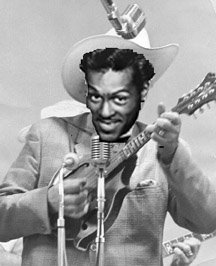
Chuck Monroe


From acousticphd on the message board of www.mandolin.com .

A great melding of two great musical pioneers, Chuck Berry and Bill Monroe.

Sunday, May 28, 2006

102 Itche Goldberg. My Most Inspirational Teacher


The New York Times May 27, 2006. By DAN BARRY .Stubborn as His Kultur, the Old Man Lives. On the eighth floor of an ancient office building in the Flatiron district, a fixture is missing. Knock on Room 820, and a young woman says her company has been there for just a couple of months; try the next door. Knock on Room 816, and nothing. Peer through the mailslot, emptiness.But around the corner, a maintenance man reading a Spanish news paper in the utility closet has news of that missing fixture: "The old man,he not here anymore."That's right: The old man, Itche Goldberg, not here anymore. For decades, he toiled on this floor, in an office crammed with books andideas, to produce what was once a premier Yiddish literary journal,Yidishe Kultur. It was published monthly, then every other month,then a few times a year, and then, finally, once, in 2004.Mr. Goldberg would take an Access-A-Ride van to the office, where he wrote, read manuscripts, maintained correspondences and tried to raise money to keep the periodical going. But just as the desire for sophisticated criticism of Yiddish literature gradually waned, so too did his ability to get to an office five days a week.Understandable, given that he is 102.A few weeks ago, the office of Yidishe Kultur was closed, but only inthe physical sense. It continues to live within Mr. Goldberg, who clings to the belief that support will come, money will materialize,and his beloved Yiddish culture, to which he dedicated a longlifetime, will thrive."It isn't easy," he says. He says this often, but to hear him say it,you detect more hope than despair.Mr. Goldberg sits in his West Side apartment's crammed study,white-haired and small, fiddling with the translucent hose feedingoxygen to his nose. A portrait of him, much younger, hangs on thewall. Papers spill from shopping bags. Pipes he has not smoked in aquarter-century gather dust. And surrounding him, books, books,books, almost all in Yiddish.LOOK at these walls, I beg you," he says. "If I couldn't have these writers..." He banishes the thought, then adds: "With all this I became part of a culture. And it kept us going quite a while."For many who care about highbrow Yiddish culture, Mr. Goldberg is a keeper of the flickering flame. "A titan," says Thomas E. Bird, aprofessor of East European languages and literature at QueensCollege. "A brilliant scholar of literature. A master teacher of generations."But how does one succinctly sum up 102 years?Born in 1904 in what is now Poland, suffered deprivation andprejudice, demonstrated scholarly aptitude, moved to Toronto, began teaching Yiddish, married a social worker named Jennie who turned 100 in December got involved in communist Yiddish culture, helped to establish Yiddish schools across the country, published a children'smagazine.Wrote and edited, all to further a language left for dead by theNazis. Raised two children, Susan and David. Feared the knock on the door during the McCarthy era. Lived through the bitter quarrels within the Yiddish left. Taught, lectured, wrote, edited, survived.Mr. Goldberg skips over this point and stops at that one, pausinghere to recall the Marxist scholar Morris Schappes and there toemphasize that being a secular Jew does not mean he is anti-religious. He delivers a brief lecture about Yiddish labor poetry, then asks, not for the only time, "Are you aware of this?"His longtime editorial assistant, Shoshana Balaban-Wolkowitz,materializes to check on his visitor. "You want something to drink?"she asks. "Almost cold ginger ale? Very bad coffee?"Mr. Goldberg continues his lecture, speaking with a nimble wit thatseeks to nurse humor from language whenever possible. When he stepson his air line, for example, he mimics a telephone operator's flatvoice: "Line 1."Unable at one point to immediately summon his whereabouts in 1930, heconfides, "By the way, things slip for me.""That's O.K.," he is reassured."No, it's not O.K.," he answers quickly, then returns to emphasizingthe importance of Yiddish as a central means of expression for Jewish culture. Fixing his gaze on his visitor, he says, "I hope what emerges is a certain stubbornness, a certain belief, a certain creativity that we cherish."Mr. Goldberg gently indicates that he has better things to do than totalk more about himself. But yes, he still reads, with the assistance of a magnifying lamp on his desk that enlarges print.As a matter of fact, he says, he is re-reading his own latest book,"Essayen Tsvey" ("Essays Two"), the recent publication of which"surely makes him the oldest writer ever to have published a newbook," according to The London Times Literary Supplement.The 467-page book contains more than two dozen essays by this erudite Yiddish fixture. Among them is one called, simply, "The Story of My 100 Years."E-mail: dabarry@nytimes.com

Wednesday, May 17, 2006

Who's Illegal?

WHO'S MORE ILLEGAL HERE? BILL O'REILLY & GEORGE BUSH OR A DESCENDANTOF AZTECS AND INCAS? ROBERT MIRANDA, HISPANIC VISTA - Mexicans come from 10,000 years ofhuman history and all of it in the conquered lands now known inhistory books as Mesoamerica and the United States of North America.Puerto Ricans, Cubans, Columbians and all the ethnic peoples that makeup Latin America and the Caribbean basin come from native tribes thatflourished long before the invasion of the Spanish Europeans and theintroduction of African slaves into this Hemisphere. . .Latinos are a people who remember our ancestry. We know that the landsthat were taken after the Indian Wars and the Mexican - American War,are ancestral lands that many Mexicans consider to this day as part oftheir ancient history.Who you calling "illegal?"The Aztecs and Incas, Apache, the Comanche, Pueblo Indians and all thenative people who for thousands of years harvested these lands andbuilt cities, and lived free under their own set of laws and rules,thrived and prospered. . .These lands stolen by the greed and manipulations and war of those whoarrived on ships from Europe, and then began stealing land that wasnever theirs, today have descendents who have inherited their wealthfrom this theft and have turned to the descendents of the nativepeople and have called them "illegal".Who you calling "illegal?"The blood of Geronimo, Orocobix, Cochise and Pope, of the PuebloIndians reminds us conscious Latinos - Chicanos of our legacy andancient history. I'm supposed to surrender this history because LouDobbs, Rush Limbaugh and Milwaukee's local right-wing talking headssay that I must? . . .Who you calling "illegal"?http://www.hispanicvista.com/HVC/Columnist/posiojr/051006osio2.htm